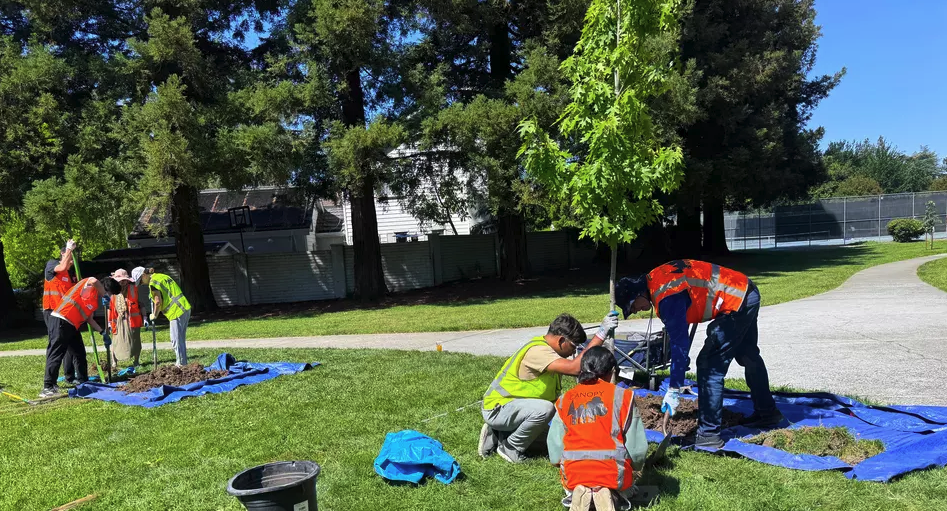
Santa Clara County's new 40-year Urban Forest Master Plan highlights community tree planting in Palo Alto, including a Hoover Park event where Palo Alto High School students, volunteers from the Alpine Chapter of Young Men's Service League and other residents planted saplings alongside the nonprofit Canopy.
The plan went before the county's Housing, Land Use, Environment and Transportation Committee on Thursday, Aug. 20. Committee staff are expected to forward recommendations to the Board of Supervisors, though no vote date has been set.
If approved, the plan would provide a 40-year roadmap for Santa Clara County and its 15 cities to grow and maintain their urban forests. Implementation would require the county and cities to pursue a mix of funding sources, including state and federal grants.
$101.4 million in annual benefits
An analysis produced for the county by Davey Resource Group estimates that existing trees across Santa Clara County already generate about $101.4 million in ecosystem benefits each year, removing roughly 25 million pounds of air pollutants, managing 864 million gallons of stormwater and capturing 464,600 tons of carbon.
The plan proposes a Climate-Ready Species List of drought-tolerant, pest-resistant trees suited to warming conditions, and uses tree equity scores developed by the national nonprofit American Forests to identify where canopy gaps overlap with lower-income and historically underserved neighborhoods. Priority planting areas include schools, parks and transit corridors.
Palo Alto's local forestry picture
Palo Alto already maintains nearly 66,000 trees through its Public Works Department's Urban Forestry Section. But a February 2026 Great Oak Count released by the city and Canopy found that seven neighborhoods, including Barron Park, Professorville and Old Palo Alto, have each lost native oaks.
Since 2016, Canopy and the city have planted more than 1,500 trees south of Oregon Expressway through the South Palo Alto Tree Initiative, most of them drought-tolerant or native species.
"It's one of the few times you can show up on a Saturday morning and in two hours see the results of your work that will last 100 years," Canopy Executive Director Jean Paul Renaud said in the county's announcement of the plan.
Regional coordination ahead
Kyle Peczowski, a senior management analyst with the county's Office of Sustainability and Resilience and a master arborist, said the plan is built around regional support so smaller cities don't have to build forestry programs on their own. The county's Office of Sustainability and Resilience supports the Santa Clara Valley Urban Forestry Alliance, a collaborative that includes Palo Alto-based nonprofits Canopy and Our City Forest.
Progress will be tracked through annual reports and five-year air quality reviews, with canopy growth measured especially in disadvantaged communities. The county also plans to build a consolidated tree-inventory data system that could become a regional forestry hub within 10 years.
The Board of Supervisors has not yet scheduled a hearing on the plan.