A downtown Palo Alto gallery is inviting residents to step inside an interactive digital artwork this summer, no admission fee required.
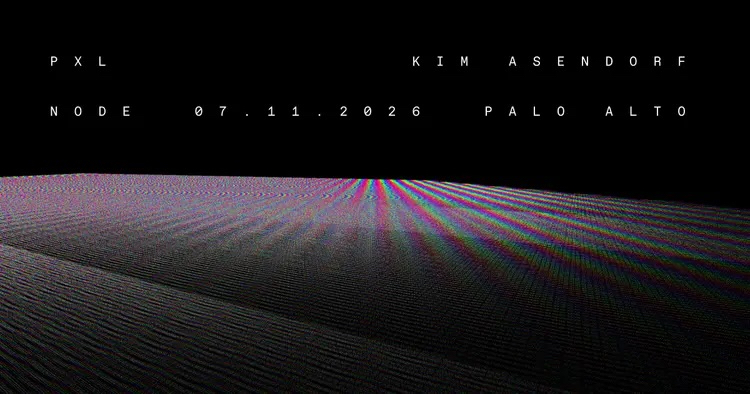
NODE, the nonprofit digital art space at 180 University Ave., opened its PXL exhibition by German artist Kim Asendorf on Saturday, July 11, 2026. The show runs through Sunday, Sept. 13, and features three works that turn the humble pixel into sprawling, interactive visual systems visitors can touch and shape.
Asendorf, born in Kassel, Germany, is best known for creating the open-source Pixel Sorting algorithm in 2010, a foundational tool in generative and glitch art. His work has appeared at Transmediale in Berlin, Eyebeam in New York, and ZKM Karlsruhe, and he was among the first 15 artists selected for the MoMA Postcard project.
The three pieces on display are PXL DEX (2025), PXL POD (2026), and PXL NET (2026). One standout for visitors: PXL POD includes a MIDI controller in the gallery that lets people rotate virtual cylindrical objects, shift perspective, and explore the pixel systems Asendorf has set in motion, according to NODE's program page.
PXL NET requires specialized high-performance computers to render its more than 100 million pixels. NODE is using advanced graphics cards to display the piece, which cannot be fully experienced on a home computer or phone.
"It is curious that the pixel, that most rigid and geometric of visual units, should become, in Asendorf's hands, the material for something so close to painting," gallerist Mimi Nguyen wrote in the exhibition's program notes. "Every point of light remains visible, distinct, irreducible."
The exhibition is the third major show at NODE since the nonprofit opened on Friday, Jan. 23, 2026, with "10,000," an exhibition centered on Larva Labs' CryptoPunks. Beeple's "INFINITE_LOOP" followed in April 2026. NODE was founded by Micky Malka of Ribbit Capital and his wife Becky Kleiner, backed by a $25 million endowment. When the gallery opened in January, more than 1,000 people traveled to Palo Alto for the opening weekend, many visiting the city for the first time, according to Right Click Save.
Admission is free. The gallery, about a mile from Stanford's campus, is open Thursday and Friday from 6 to 10 p.m., Saturday from noon to 10 p.m., and Sunday from noon to 8 p.m. The space is closed Monday through Wednesday. Visitors can learn more at nodefoundation.com.