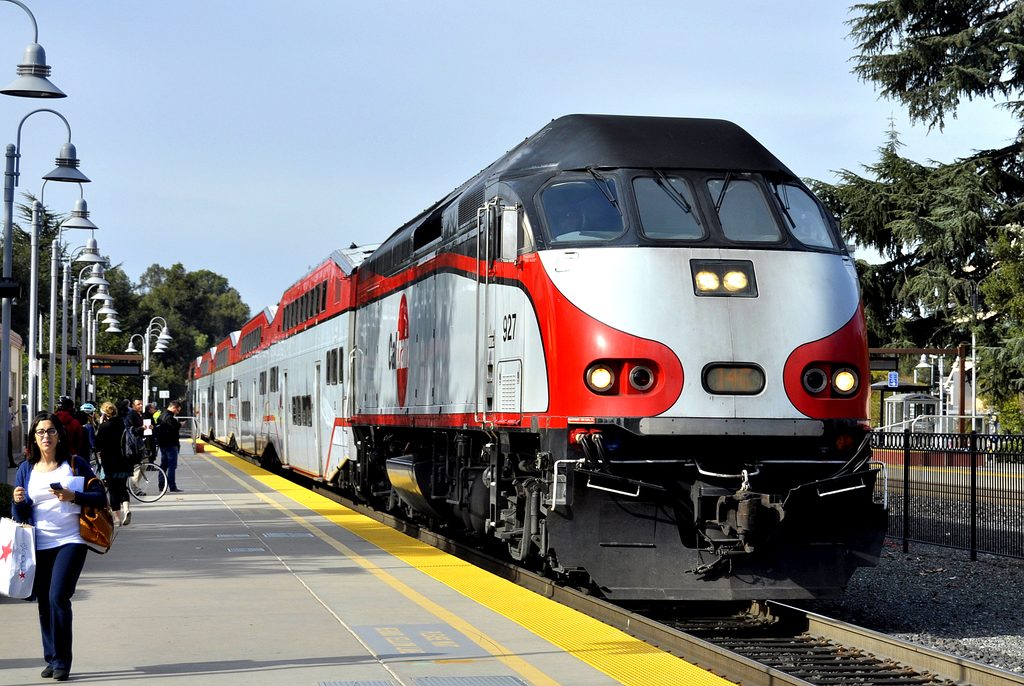
A group of Bay Area voters filed suit Tuesday, Aug. 18, in Santa Clara County Superior Court to block a regional transit sales tax from the November ballot, arguing the measure's language pushes voters toward "yes."
For Palo Alto residents, the Connect Bay Area Act would add a half-cent to every dollar spent in Santa Clara County for 14 years. The revenue, estimated at $980 million annually across five counties, would fund Caltrain, VTA, BART, SamTrans, AC Transit and Muni.
Attorney Jason Bezis of Lafayette filed the petition on behalf of 10 voters, including Gregg Dieguez, president of the Committee for Affordable Bay Area Transit.
"We want it to be an unbiased statement of what's going to happen," Dieguez told KQED.
The petitioners object to specific words in the ballot question approved in July by the Public Transit Revenue Measure District, which is made up of the Metropolitan Transportation Commission's board of directors. They want references to "preventing major service cuts" and "preserving" transit agencies stripped out, calling those terms biased. Their proposed replacement would swap "preserving" for "funding" and delete the service-cuts language entirely.
The petition also challenges the revenue figure printed on the ballot, arguing MTC's own projections show the tax would generate approximately $1.2 billion annually, not the $980 million disclosed on the ballot question.
The Committee for Affordable Bay Area Transit contends transit operators could tap existing capital funds, reduce overtime pay or renegotiate labor contracts rather than rely on new tax revenue.
Rebecca Long, MTC's director of legislation and public affairs, said in a statement that both ballot documents were prepared in accordance with California election law and that the district will defend them on the schedule the court sets.
Santa Clara County Registrar of Voters Matt Moreles said in the petition that the case must be resolved by Friday, Aug. 28, so his office can meet election printing deadlines. If no ruling comes by then, the measure stays on the ballot as written.
What's at stake for Palo Alto riders
Caltrain, which serves multiple Palo Alto stations, faces an average annual deficit of $75 million starting in fiscal year 2028, according to The Voice of San Francisco. Ridership sits at 71% of pre-pandemic levels, and fare revenue has dropped from 72% of the agency's budget before COVID-19 to roughly 30%.
If the November measure fails, Caltrain has warned it would cut weekday trains to hourly frequency, end weekday service at 9 p.m., eliminate all weekend service, close stations and cancel special-event trains, the outlet reported.
Connect Bay Area campaign spokesperson Jeff Cretan told KQED the same day that the campaign's focus is "explaining to voters that, if we don't pass this measure, there will be catastrophic cuts to public transit that will hurt communities in all five counties."
An EMC Research poll of 1,700 likely voters across the five counties showed 54% would vote to approve the measure. Because the act was placed on the ballot by a coalition of advocacy groups rather than by legislative action, it needs only a simple majority to pass.
No court hearing date has been announced. The next hard deadline is Aug. 28.