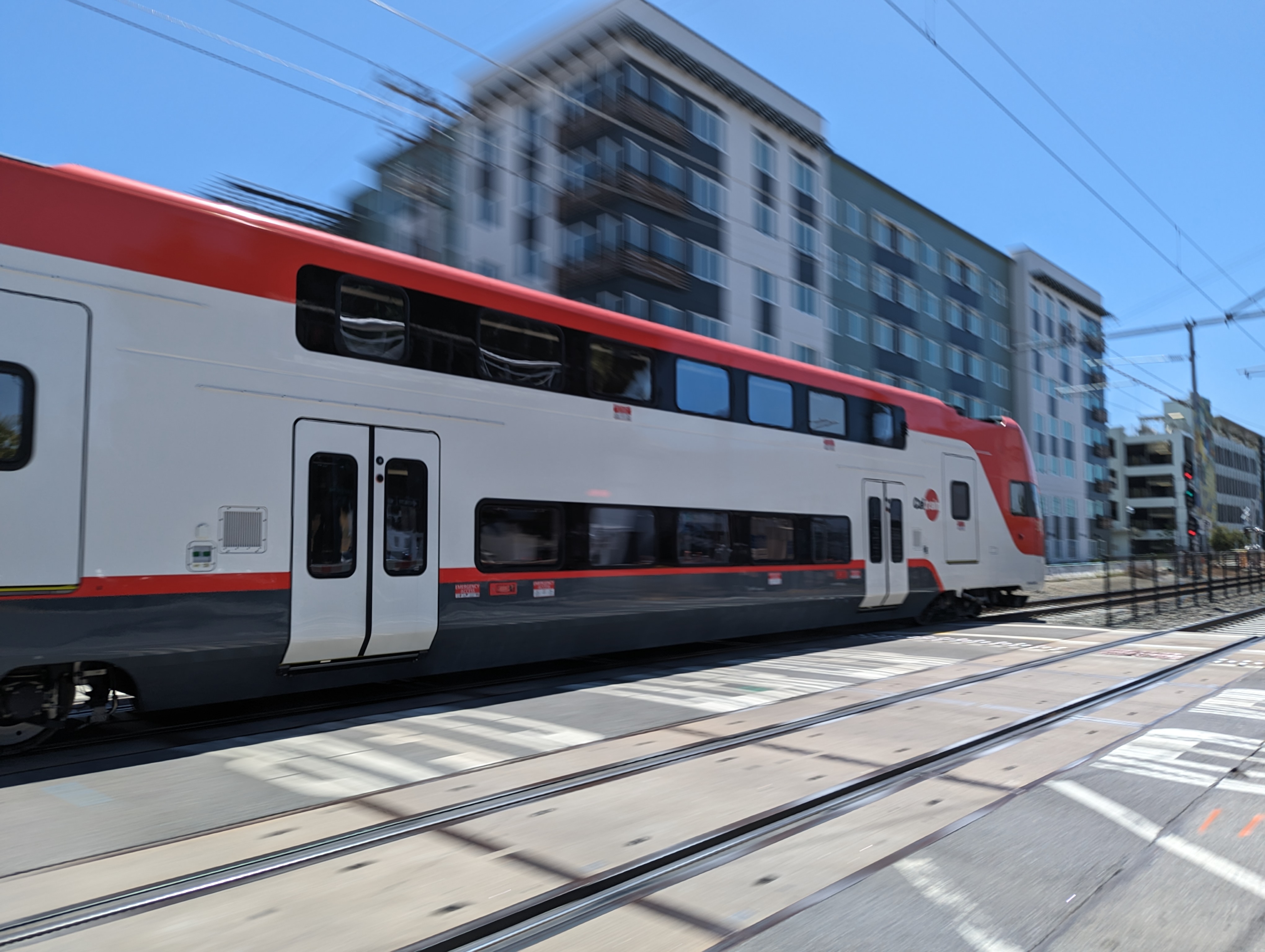
Residents near Palo Alto's northernmost Caltrain crossing will keep hearing 100-decibel train horns well into fall after a traffic safety problem pushed back the city's quiet zone timeline.
Caltrain's Rail Sentry system, which uses LiDAR and cameras to monitor vehicle and pedestrian movements near the tracks, detected cars backing up from El Camino Real onto the Palo Alto Avenue rail crossing. The discovery forced the city and Caltrain to agree that additional safety measures are needed before federal regulators will authorize silencing the horns.
"This is obviously a problem with oncoming trains, and the City agrees with Caltrain that additional safety measures should be pursued prior to implementation of a quiet zone," city spokesperson Meghan Horrigan-Taylor said, according to Palo Alto Online.
City Manager Ed Shikada disclosed the delay in his summer recess report to the City Council on Wednesday, Aug. 5, writing that the city will work with Caltrain, the Federal Railroad Administration and the California Public Utilities Commission to resolve the safety concerns.
What was finished, what wasn't
The city completed most of the FRA's required physical upgrades in June, including a median island, bicycle striping and extensions of the protected left-turn lane. Pavement restriping still needs to happen before the quiet zone can be authorized, and Horrigan-Taylor said that work will fall within the existing fall 2026 project timeline.
No one has said how much additional time the safety review will add.
The next formal step remains unchanged: the FRA must issue a Notice of Establishment. Until then, horns will continue sounding from 5 a.m. with the first Caltrain until the last train passes well after midnight.
Police enforcement, no new spending
The city has increased police presence near the crossing to watch for cars illegally stopped on the tracks. Horrigan-Taylor said the enforcement uses existing police resources at no extra cost.
Other crossings unaffected
The delay is specific to Palo Alto Avenue. Quiet zone work at the city's three other at-grade crossings (Churchill Avenue, Meadow Drive and Charleston Road) proceeds on separate timelines.
Churchill Avenue's quiet zone became a budget priority after the Feb. 3 death of Summer Devi Mehta, a 17-year-old Palo Alto High School student, at that crossing. Students and parents said hearing the horn multiple times a day was a painful reminder of their classmate. The City Council committed $1 million in its fiscal year 2026 budget to Churchill's quiet zone implementation and, in May, voted against temporarily closing the crossing to traffic, citing congestion concerns and the risk of jeopardizing future quiet zone plans.
The Council approved gates at the Churchill, Meadow and Charleston crossings in November 2025 to enable quiet zone eligibility at those locations.
The horns stay on for the forseeable future.
Caltrain's own data shows the scope of the underlying problem: the railroad reported approximately 238 vehicle track incursions system-wide over the four years before August 2025. The Rail Sentry system generates alerts but does not physically prevent cars from entering the crossing.