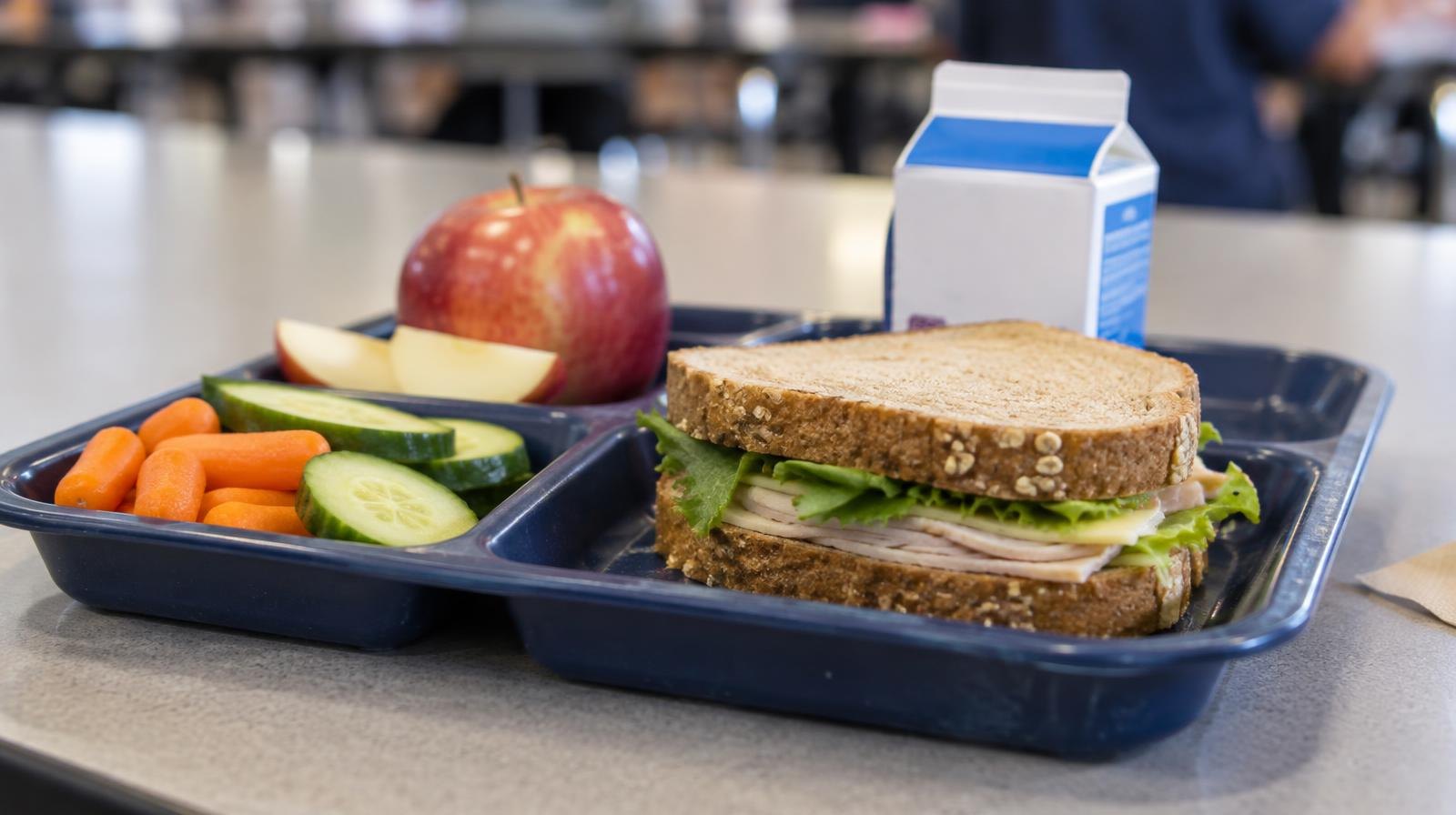
Palo Alto Unified will need to overhaul its school menus under a California law phasing out ultra-processed foods, and a new Stanford Medicine study warns the transition will be costly and difficult for districts statewide.
The study, published Sept. 28 in the journal Public Health Nutrition, found that food service directors across 20 San Joaquin Valley school districts identified four top barriers to compliance: tight budgets, limited staff, difficulty sourcing less-processed ingredients and kitchens built only to reheat packaged meals.
AB 1264, the Real Food, Healthy Kids Act, was signed by Gov. Gavin Newsom on Oct. 8, 2025. It is the first law of its kind in the nation. A ban on six synthetic food dyes in school foods takes effect Dec. 31, 2027. Schools must begin phasing out restricted ultra-processed foods by July 1, 2029, vendors must stop offering those products by July 1, 2032, and reimbursable meals must be fully free of them by July 1, 2035, according to the enacted bill text.
PAUSD's starting point
The study focused on lower-income, rural districts, not suburban schools like PAUSD's. But the law applies to every public school in California.
PAUSD contracts with Sodexo for food service management. The Board of Education approved a contract extension for 2026-27 at its April 21 meeting. A March 2026 district update highlighted scratch-cooked dishes like arroz con pollo on secondary school menus, describing the effort as part of the district's commitment to "real, wholesome meals."
No public PAUSD board discussion of AB 1264 compliance plans or costs has appeared in available records. How the district's scratch-cooking efforts and Sodexo partnership will align with the law's timeline remains an open question.
Budget math
Federal and state funding reimburse districts about $4.60 per lunch served. Many schools rely on part-time workers trained to reheat pre-made food, not cook from scratch. Shifting those employees to full-time positions would require larger salary and benefits budgets.
Districts can buy cheap raw commodities through the USDA and send them to processors in exchange for ready-to-serve items like chicken nuggets. That pipeline, the study notes, can increase ultra-processed food on the menu.
"It's easy to say, 'Let's remove ultra-processed foods from school meals,' but school districts will likely face many challenges in implementing this policy," said Anisha Patel, professor of pediatrics at Stanford Medicine and the study's senior author.
Fresno's kitchen problem
Amanda Harvey, director of nutrition services for Fresno Unified School District and a member of the study's community advisory board, described the obstacles in concrete terms. When her team tried to make sandwiches from scratch at 50 elementary schools, the local health department denied the request. Those heat-and-serve kitchens lacked proper sinks, drains and hoods. Permitting all 50 would have cost millions from the district's infrastructure budget.
Fresno Unified worked around the problem by preparing sandwiches at a central kitchen. Smaller districts may not have that option.
Harvey's team also hit procurement walls after removing products with food dyes. Dye-free pickles proved expensive and hard to source, leading to periodic shortages.
Federal money on the table
A $32.5 million federal initiative called DEPEND, announced Aug. 26 by the U.S. Department of Health and Human Services, aims to help schools replace processed foods with nutrient-dense meals. Awards are expected to range from $75,000 to $2.5 million.
Several other states are considering legislation similar to AB 1264, according to the Stanford study. Lead author Andrea Pedroza-Tobias, now an assistant professor at the University of California, Irvine, said lawmakers will need to direct more funding to school food budgets to put the mandate into practice.