A freshly replicated 52-foot mural, 20 Rodin bronzes and a sculpture weighing more than 200 tons are all free to visit on Stanford's campus. A mobile app maps out five self-guided tours so anyone can explore the collection on foot.
Stanford's public art program spans more than 80 works created between the 19th century and 2026, according to a Stanford News guide updated Tuesday, Aug. 11. Every piece is accessible to the public year-round at no cost. The Stanford Mobile app, also free, offers an interactive map and five themed walking routes: "BeWell Arts Tour," "Art and Science," "Sculptural Landscapes," "Around the Museums" and "Muralism and Activism."
The collection's newest highlight is a 2026 replication of Malaquias Montoya's 52-foot mural on the facade of El Centro Chicano y Latino. Montoya, a visiting instructor at Stanford, originally painted the mural on wood panels in 1980–81 with the help of students and staff. This year, muralist Greta McLain, a former student of Montoya's, recreated the work using UV-protected paints on specialized fabric mounted on durable metal composite panels. The restored mural anchors the app's "Muralism and Activism" tour.
Four places to start
Several stops sit along popular bike and walking routes through campus.
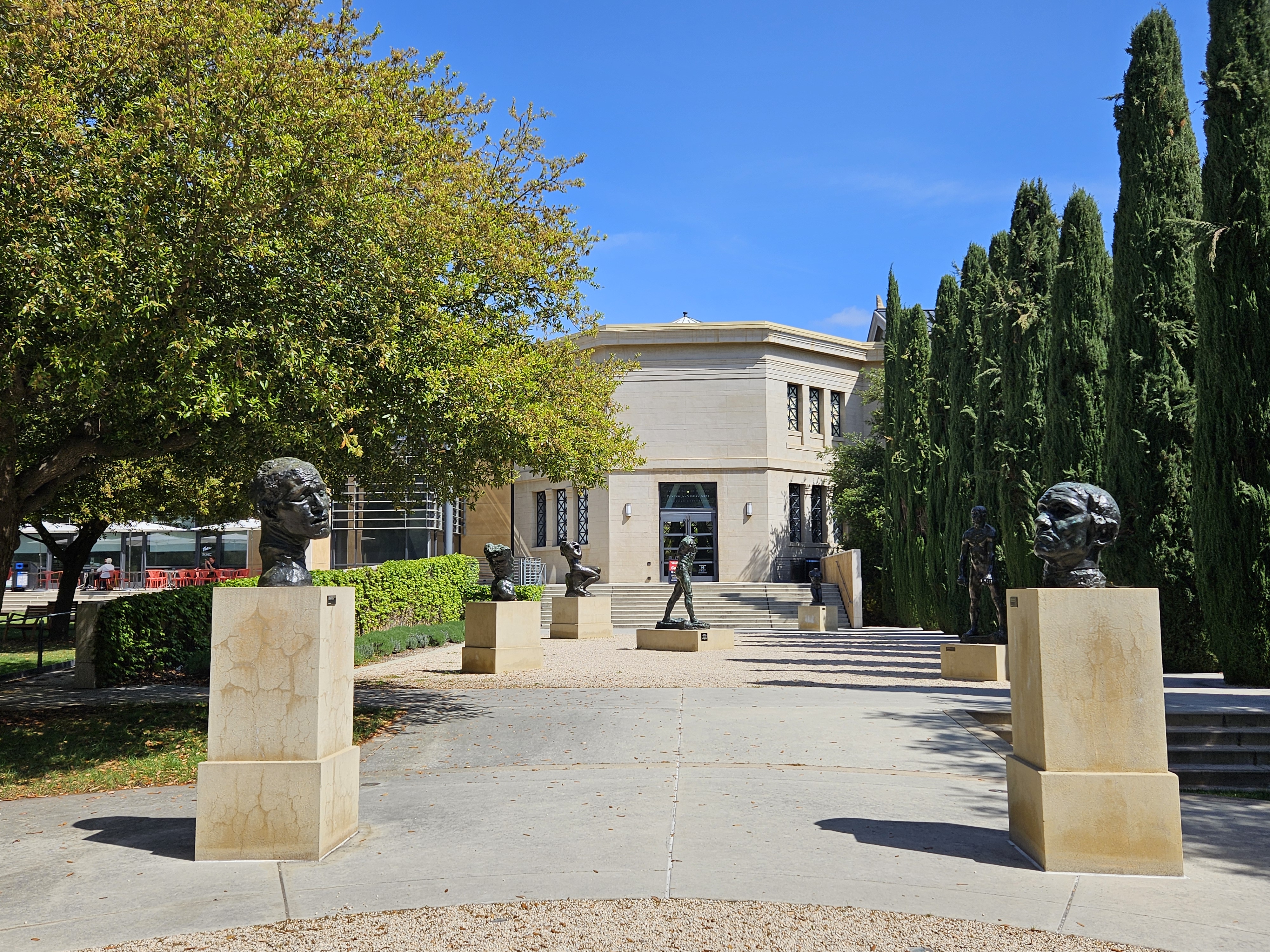
Rodin Sculpture Garden: One acre of cypress trees and gravel paths next to the Cantor Arts Center holds 20 monumental bronzes, including "The Gates of Hell," cast by the Coubertin Foundry in 1981 using the lost-wax process. The garden is modeled after the Bagatelle Gardens in Paris.
Canfield Court: Between Stanford Law School and Green Library, about half a dozen works cluster here, including Alexander Calder's "Le Faucon (The Falcon)" from 1963, which once stood in front of Calder's studio in Saché, France. Alia Farid's "Amulets" (2024), two translucent forms made of blue faience and polyester resin, is the court's most recent addition.
Papua New Guinea Sculpture Garden: At the corner of Santa Teresa Street and Lomita Drive since 1994, this garden holds 40 carved posts, freestanding figures and garamut slit drums created by 10 artists-in-residence from the Sepik River region. Improved lighting and new smooth, flat walking paths make it easier to navigate.
Stanford Arboretum: Beverly Pepper's "The Stanford Columns" (2022), four oxidized Cor-Ten steel columns each weighing 3 to 5 tons, stand among California oaks. Nearby, Jedd Novatt's towering steel sculpture "Chaos Kosmos" was installed at the Center for Academic Medicine in February 2026.
Richard Serra's "Sequence" (2006), on the "Sculptural Landscapes" tour, measures 67 feet long, 42 feet wide and 13 feet high. It weighs more than 200 tons.
No reservation or campus ID is required. The Stanford Mobile app is a free download on iOS and Android.