In the centenary year of Allen Ginsberg's birth, his handwritten drafts of "Howl" and his travel journals from India are now on display steps from downtown Palo Alto, according to Stanford Libraries.
Also on view: a diary entry he scrawled at age 11 declaring "I'll be a genius of some kind or other, probably in literature. I really believe it."
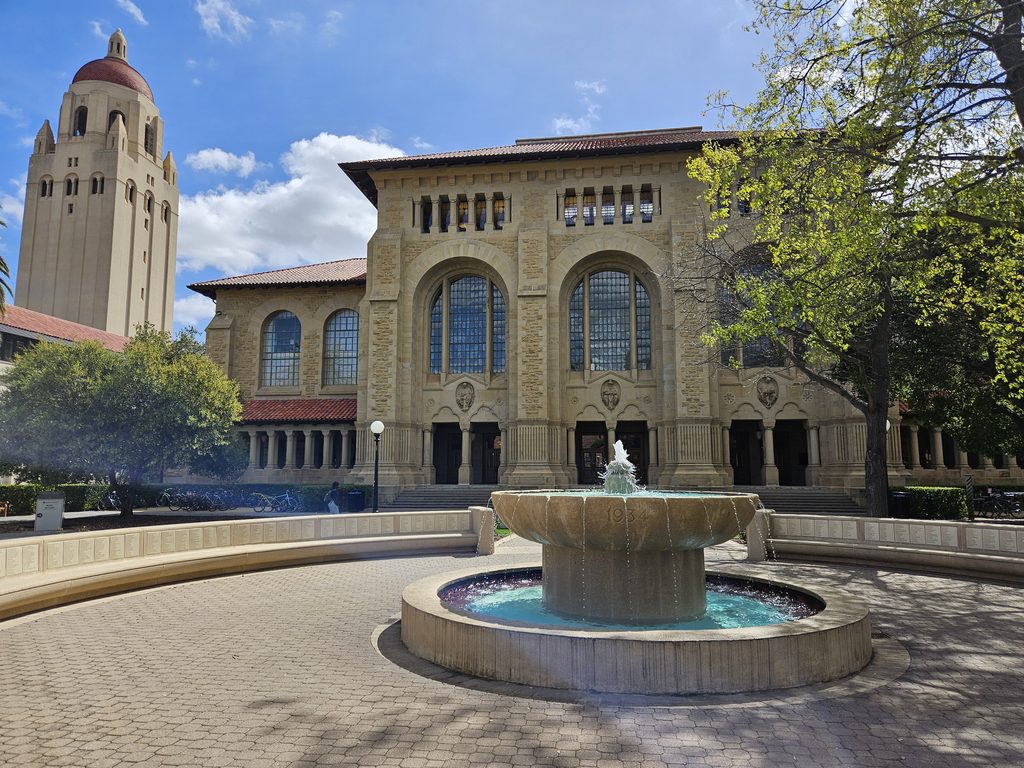
"Ginsberg at 100: Selections from the Allen Ginsberg Papers at Stanford" is the university libraries' first exhibition dedicated to the Beat poet. It occupies the Peterson Gallery and Munger Rotunda of Cecil H. Green Library, 459 Lasuen Mall, and closes Sept. 5.
The show draws on a massive archive. Stanford's Department of Special Collections acquired the Allen Ginsberg Papers in 1995, and the collection now spans 1,350 linear feet and 35,388 catalogued items. Notebooks, correspondence with Jack Kerouac and William S. Burroughs, original typescripts, photographs, audiotapes and posters fill the holdings.
"Thanks to Ginsberg's uncanny premonition to save almost everything (including the trimmings he clipped from his beard!), the archive is the central database for the twentieth-century American underground and beyond," said J. Christian Greer, a lecturer at Stanford, according to Stanford Libraries.
Curator Rebecca Wingfield, who holds the title of Curator of American and British Literature in Stanford's Humanities Resource Group, selected items tracing the creative process behind "Howl for Carl Solomon" and "Kaddish for Naomi Ginsberg," Stanford Libraries reported. Visitors will also find Ginsberg's homoerotic love poetry, the anti-war poem "Going to Chicago" written on a plane to the 1968 Democratic National Convention, a list of psychedelic drugs he wished to explore along with their effects, and a rough draft of his poetic credo intended as a preface to his Collected Poems 1947–1980. Historic audio recordings accompany the displayed artifacts.
The Bay Area connection runs deep. Ginsberg first read "Howl" publicly at the Six Gallery in San Francisco in October 1955. City Lights Books published it the following year, and a San Francisco obscenity trial gave the poem national notoriety. He later appeared at the Human Be-In in Golden Gate Park in January 1967.
Michael A. Keller, Stanford's Ida M. Green University Librarian, called the papers a transformative acquisition that holds "immense importance for the San Francisco Bay Area" and serves as a destination collection for humanities researchers.
The exhibition was produced and designed by Deardra Fuzzell, with assistance from Elizabeth Fischbach, Kylee Diedrich and Pasha Tope, according to Stanford Libraries.
The gallery is open Monday through Saturday, 10 a.m. to 5 p.m., and Sunday, noon to 5 p.m. Visitors must register with a valid government ID to enter Cecil H. Green Library.