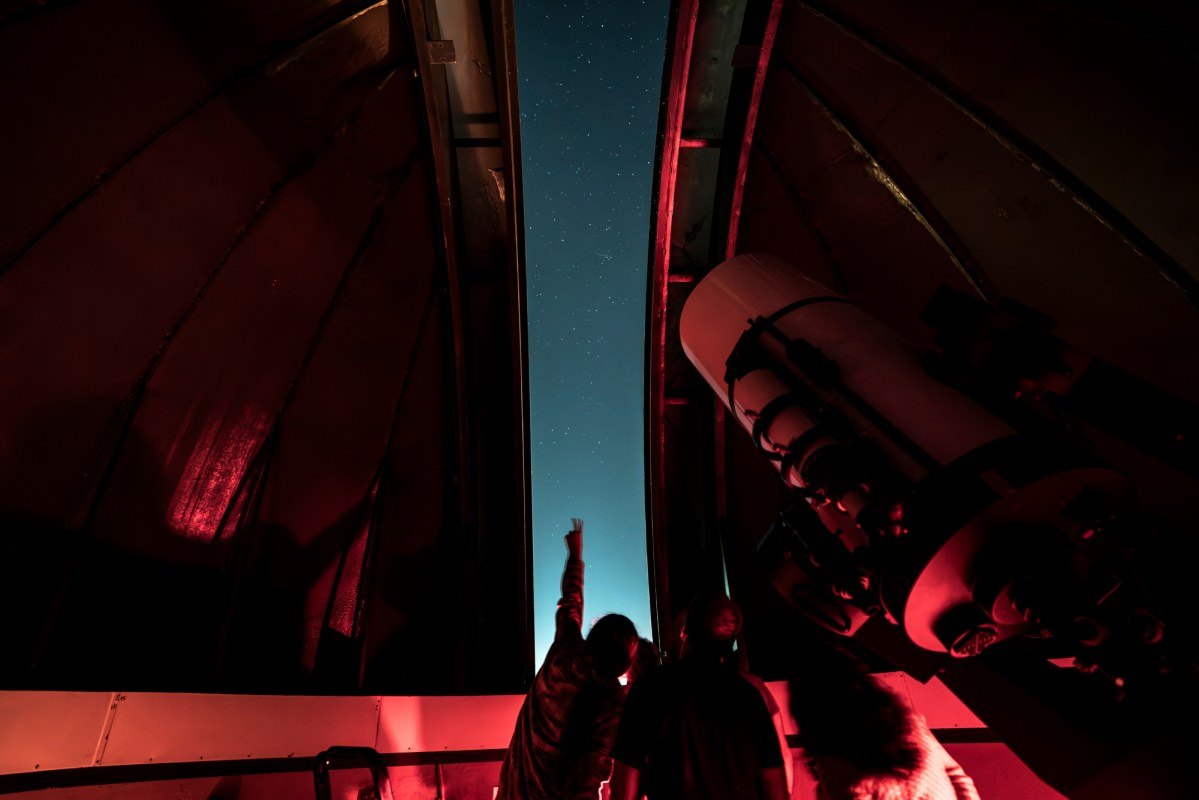
Every clear Friday night, a handful of volunteers unlock the dome at Foothill College's observatory in Los Altos Hills and point a 16-inch telescope at whatever's worth seeing. Star clusters, nebulae, distant galaxies. No ticket, no reservation, no cost.
The Peninsula Astronomical Society has been running this program since 1977, when California's Proposition 13 gutted community college budgets and Foothill could no longer staff its own observatory. The club cut a deal: volunteers would keep the public nights going as long as the college maintained the equipment. That handshake arrangement has held for nearly 50 years.
The club itself is older still. Founded in 1949, PAS predates Silicon Valley. A member donated his personal telescope to Foothill when the college opened in 1960, on the condition it hold regular public viewing sessions. The college built an observatory and opened its doors on Friday nights.
Gary Baker, the club's president since 2010, started volunteering in 1999 after moving to the Bay Area. He said the reactions from first-time visitors keep him coming back.
"There are 5- or 6-year-old kids that just won't stop asking questions," Baker told the Mountain View Voice in a July 15 profile of the organization.
Allen Frohardt has operated the telescope and guided visitors for 15 years. Board member Antonio Martinez has helped connect PAS to speakers at Stanford's Kavli Institute for Particle Astrophysics and Cosmology. The club's April 2026 lecture, featuring Stanford master's student Michelle Park on the Vera Rubin Observatory in Chile, drew close to 100 attendees, a record for the monthly lecture series, according to the Mountain View Voice.
PAS also hosts star parties once or twice a year that can draw a thousand people in a single night.
The observatory sits at 4100 Perimeter Road, roughly five miles from downtown Palo Alto. Friday sessions run 9 to 11 p.m.; Saturday morning solar viewing runs 10 a.m. to noon. Both are weather-dependent and require no RSVP. Visitors can check the observatory webcam at pastro.org around 9 p.m. Fridays to confirm the dome is open.
Saturday mornings offer a different show. The telescope is aimed at the sun or brighter planets like Venus and Jupiter, making the sessions accessible for families with young children who can't stay up past 9.
Membership costs $25 a year and supports the free programming. Monthly club meetings with guest speakers happen the second Friday of each month at 7:30 p.m. and are open to the public. The next monthly meeting is Friday, August 14.
Two summer sky events give extra reason to look up: the Perseids meteor shower peaks overnight Wednesday, August 12, into Thursday, August 13, and a deep partial lunar eclipse occurs the night of Thursday, August 27, with maximum eclipse at 9:12 p.m.