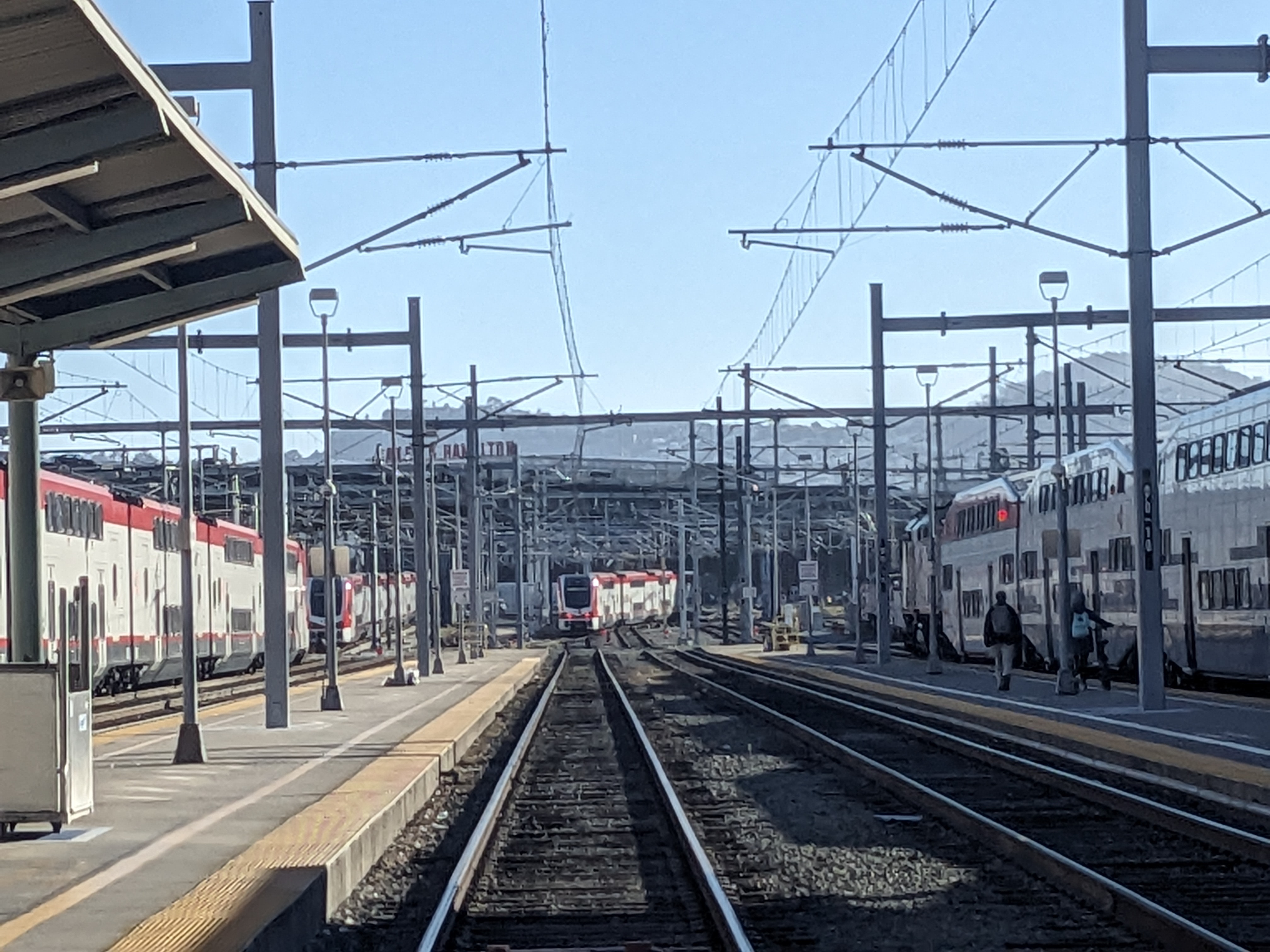
Residents near Palo Alto's northernmost Caltrain crossing still face 100-decibel horn blasts from 5 a.m. until past midnight, and the city's effort to silence them has hit obstacles at every one of its four at-grade rail crossings.
Palo Alto has been pursuing federal quiet zone designations at Palo Alto Avenue, Churchill Avenue, Meadow Drive and Charleston Road. The designation would let trains skip their mandatory four-blast horn approach in exchange for more secure four-quadrant gates that block cars, bikes and pedestrians from the tracks. But as San Jose Spotlight reported, none of the four crossings has reached that milestone, and each faces a distinct set of hurdles.
Palo Alto Avenue: LiDAR flags a safety problem
The Palo Alto Avenue crossing, nearest the Menlo Park border, was the first to win city approval for a quiet zone. As we reported Aug. 10, the city finished most of the required infrastructure by June, including a median island, bicycle striping and a longer protected left-turn lane. But Caltrain's Rail Sentry LiDAR system then detected cars backing up from El Camino Real onto the tracks.
"This is obviously a problem with oncoming trains, and the City agrees with Caltrain that additional safety measures should be pursued prior to implementation of a quiet zone," city spokesperson Meghan Horrigan-Taylor told Palo Alto Online on Aug. 5.
The city responded by increasing Palo Alto Police patrols near the crossing to watch for cars illegally stopped on the tracks, at no extra cost, according to Almanac News. City Manager Ed Shikada wrote in his summer recess report that the city is working with Caltrain, the Federal Railroad Administration and the California Public Utilities Commission to resolve the issue.
Pavement restriping still needed before federal authorization remains on track for fall 2026, Horrigan-Taylor said. The next formal step: the Federal Railroad Administration issues a Notice of Establishment.
Churchill Avenue: $1 million committed, no construction date
The City Council committed $1 million to quiet zone implementation at Churchill Avenue as part of the fiscal year 2027 budget. The push intensified after the Feb. 3 death of Palo Alto High School student Summer Devi Mehta at the crossing.
Council members decided against closing the crossing to traffic, citing congestion concerns, but prioritized installing secure gates to make it eligible for quiet zone status. Chief Transportation Officer Ria Hutabarat Lo told the Finance Committee in May that design planning is funded for fiscal year 2027, with construction in fiscal year 2028. That's one calendar year ahead of the previous schedule.
Charleston Road: Safety upgrades first
Charleston Road has seen six collisions between January 2018 and January 2024, according to federal records. The city approved a $2.2 million safety package in June funded almost entirely with federal dollars, including a pre-signal traffic light west of the tracks, ADA-compliant pedestrian ramps and new bike lane striping. Design wraps up by fall 2026; construction is slated for completion by the end of 2027. A quiet zone designation would follow.
Meadow Drive: No timeline
No target date has been announced for quiet zone implementation at Meadow Drive. City officials have confirmed only that it is on a separate timeline.
The cost of waiting
Resident John Melnychuk, a recurring advocate for quiet zones, urged the Finance Committee in May to move faster. Full grade separation, which would permanently elevate or lower roadways past the tracks, would cost $390 million to $480 million for the Meadow-Charleston corridor alone and remains years away.
"We're traumatized by the dangerous operation of Caltrain and Union Pacific in our city," Melnychuk told the committee during budget deliberations in May.
The accelerated quiet zone timeline is funded partly through Measure K, a business tax approved by voters in 2023 that raises about $9.6 million per year. Diverting that revenue to quiet zones could affect long-term grade separation funding.